Know Your Subcontractor

It’s been hard to find a concrete contractor for the footings and stem walls because people have been so busy in construction. So, I ended up seeing a referral to this one contractor reached out to him and he gave a good bid. I also met a plumber who said he would meet me and my concrete guy onsite and could work alongside the concrete contractor. On the morning we were supposed to start, my GC, Barry Howard came by and started asking some questions.

The first problem was that the concrete contractor, this Hawaiian fellow, said he was only doing the footings, not the stem walls. Barry was immediately skeptical. That certainly wasn’t the deal I had anticipated. When asked why he couldn’t do the stem walls as he had promised, he had admitted he didn’t have the “forms” that are used to create the stem walls. Those forms are about $10K, not incredibly expensive for a working contractor. The Hawaiian offered to complete the footings and suggested we find someone else for the stem walls. Barry explained to me that the second concrete contractor would be hard to find, because he would assume that there had been an issue with the footings and thus the second contractor wouldn’t want to have his work be judged by what the first person had done or failed to do. Basically, he wouldn’t want to install his stem wall on some flawed foundation. Or he might think that we got into a payment dispute with the footings contractor and that might happen to him. Also, the stem is a smaller job than doing the entire footings and stem, so to find something to do just half the job would be hard because the profit wouldn’t be there.

Barry also asked me whether I had noticed that the backhoe brought by the Hawaiian looked brand new. I had. That made me understand what Barry was saying: maybe this guy had just rented the small backhoe because he had no money and besides couldn’t afford the forms. In short, maybe he wasn’t a very good contractor. No idea, but I decided not to use him.

Likewise, the plumber I found also didn’t have a backhoe or trencher. Barry thinks it is important to have the sewer lines exactly right and believes the machinery is needed for that. The plumber said that he and his sons hand-dig the trenches. Again, Barry was like, “Why is that?” So, he, too, was put off for a bit while I figure things out. Now, I do think I have two excellent new contractors set for the concrete and plumbing, but it’s delayed things by a month. Well, better to delay a month and get the footings, stem wall, and plumbing 100% right than do it wrong and have lots of regrets later.

Enjoying the Little Things

I’ve never driven a bobcat or any sort of tracked construction vehicle before, so I had to take the opportunity to ask to see how they work. I ended up driving the smaller bobcat you can see below. It was surprisingly quiet and also had amazing air conditioning, which is a good thing for anyone who has to spend the day in one. It didn’t take me long to get a feel for the machine. Left stick moves you up and back, right and left. Right stick controls the bucket or arms or whatever is attached to the front of the bobcat–they have interchangeable front pieces, I guess.

I didn’t go very far or fast. In fact, going backwards over some undulations left on the terrain by the big bulldozer left me feeling a bit wobbly. I was probably fine, but I think it is a risky endeavor to drive one of these things over any steep slopes or even not so steep ones. Still, it was fun just to learn something a bit new and out of my normal experience. You have to take time to enjoy what you can, when you can, and the 20 minutes or so that I took learning to maneuver the bobcat was worth it.

Neighbors and Big Trees

I think any project of this kind certainly can bring challenges from neighbors. But I’ve been lucky in that my only neighbor, Eva, has been very much in favor of my project. On our side of the property line was a chain link fence and on her side was a wooden fence and in between them had grown a very big mesquite tree. Eva agreed to remove that tree and even went ahead and removed her wooden fence so that our bulldozer would have unfettered access to the tree.

Tip: We first cut the tree down quite a bit before using the bulldozer to drag the stump out of the ground. My tree guy said that instead of cutting the tree right down to the ground that he would leave a 5 foot section of the base of the tree so that it could be nudged using the bucket of the bulldozer, which would shake the roots loose. That was a good idea. Ultimately, I was there to watch as a heavy duty chain was tied to the stump and the whole thing was pulled out of the ground. I did keep a reasonable distance away during that process in the event the chain were to snap or something–that might be a really bad day! You can see the mesquite in the foreground of the photo below.

I also wanted to remove the much larger Chinese elm, I think, that you can see in the background but weeks prior Eva was hoping just to trim it. My tree guy, Lance said that you really couldn’t trim it because it was already on its last legs and likely wouldn’t survive when the footings were poured for the block wall that is eventually to be built in place of the chain link fence that you can see laying on the ground adjacent to the mesquite. When I got to the site to watch the mesquite be removed, Eva had apparently changed her mind and agreed to also remove the Chinese elm, which I think was a wise decision. After all, such a tree could collapse on any of our structures. Plus, the tree gave no shade as in Arizona, trees on the northern side of the property do nothing for shade as the sun is always in a southern degree.

You can still see a few feet of the stump, so perhaps we are just awaiting Southwest Gas to come do its job before removing the rest of the tree.

Grading, Gas Lines, and other Surprises

The first “big” step in the construction process is building the “pad” of compacted soil upon which the house’s concrete “slab” will sit. The land must be cleared of the first several inches of soil and vegetation, which here in Phoenix just means some sad weeds and grasses, and then other dirt is brought to the site to be formed into the mostly rectangular shape mirroring the building’s footprint. The extra dirt is compacted and brings the house’s slab above “grade,” meaning the level of the rest of the lot. That’s important if you won’t want to be flooded by rain obviously enough. The structure should sit “above grade.”

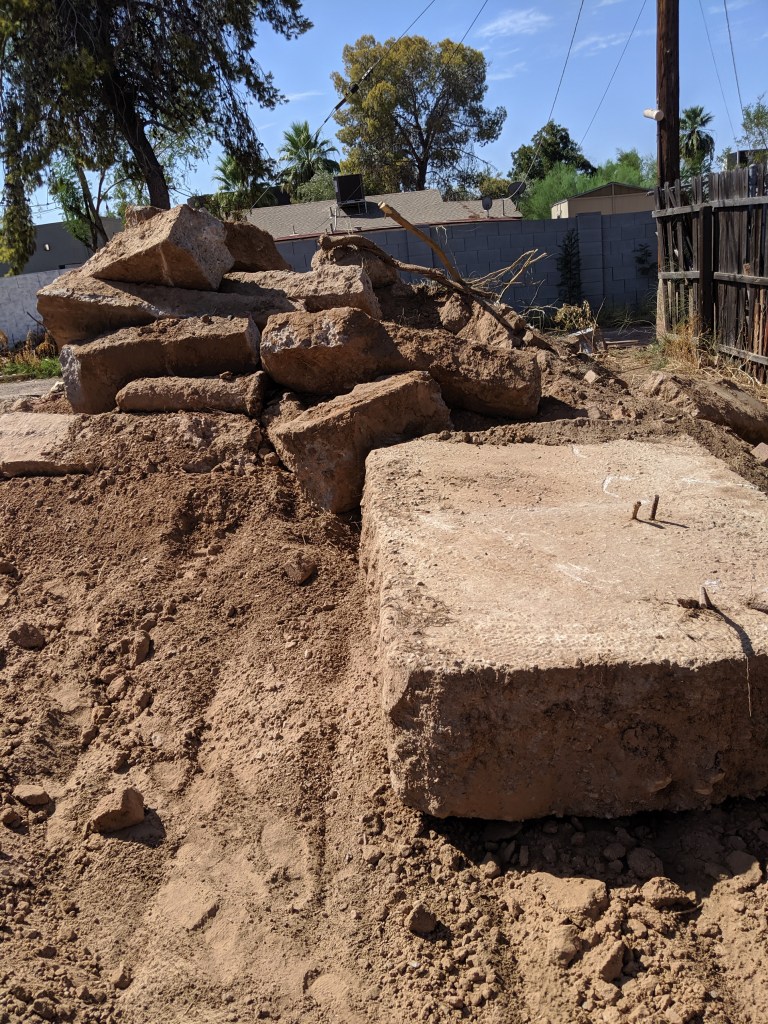
The maxim that you should learn to expect surprises–the realist’s oxymoron–certainly came into play here. Sure enough, I get a call that there is a big septic tank on the site that had to be removed. It might have been 10 feet deep into the ground or slightly more. In addition, there was some “pier” of concrete that must have been poured to support something much bigger than the simple house that had once been on the land (and used the septic tank). The pieces of concrete were at least 4′ x 8′ and were almost 2+ feet in thickness, probably larger, even. Below is a photo of the pieces of the concrete pier that we discovered when grading the land.

Unexpected concrete pier

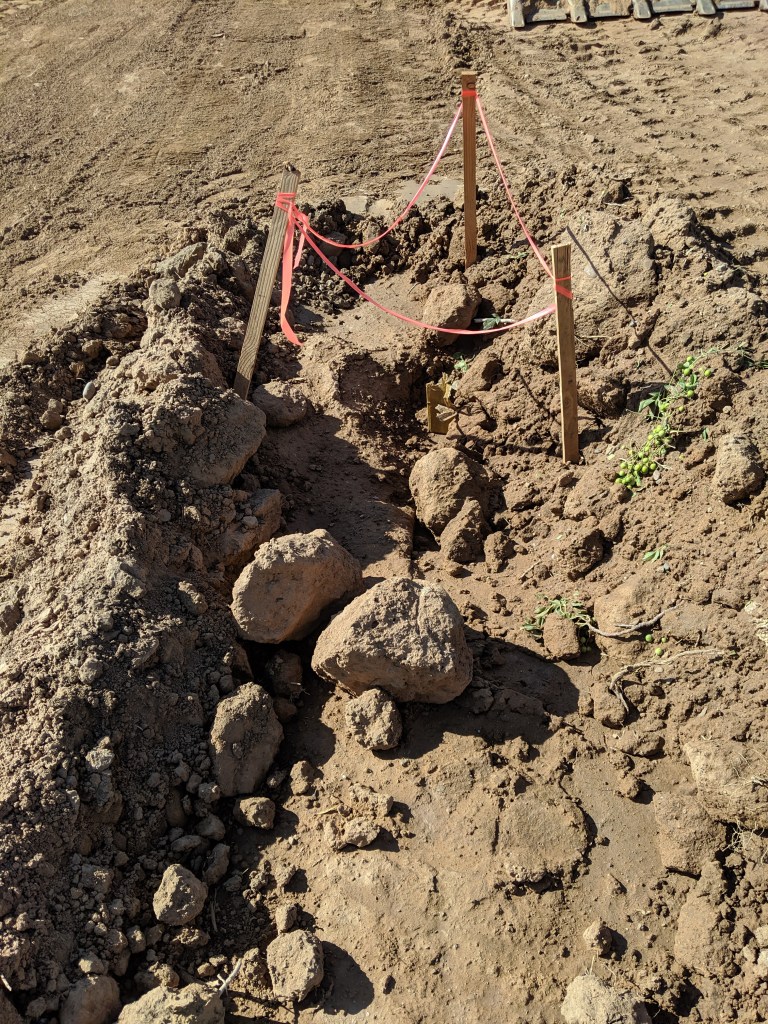
Next came the unexpected news that even though Southwest Gas had sent some subcontractor to mark the gas line, it turns out they did a very poor job and they failed to notice that a gas line continued another 60 feet or so into the property–and it was an active line! Of course, Southwest Gas was somewhat apologetic but given the Labor Day weekend, it’s postponing some of the work near the western side of the pad. Below is a photo of what my grading contractor, James Bissell discovered. James said it was very lucky that he discovered the line. He takes about 6 inches of dirt off with each pass of the huge bulldozer and it just so happened that he saw a stake with some yellow feathers–not sure if that’s how to describe what the stake had on it–and when he saw that, he stopped the digging.